Autocompose an itinerary that does not invent places.
Name where you want to go and how long you have. JourneyComposer proposes real cities, real sights, and a sensible order to see them in, drawn from open travel guides written by travellers. You approve or change every part of it before a single thing is saved.



Where. A city, a country or a region, and more than one if you want to combine them.
At a glance
Real places, not plausible ones
Every city and sight comes from Wikivoyage and Wikidata. Nothing is generated text, so nothing is a restaurant that closed in 2019 or a viewpoint that never existed.
You see it before it saves
The draft is a preview. Swap a city, drop one, add a day trip, then commit when it looks right.
A real trip at the end, not a text blob
You get stops, travel legs, sights, and a day-by-day plan you can keep editing, not a wall of prose you have to retype.
Tell it what kind of trip you want
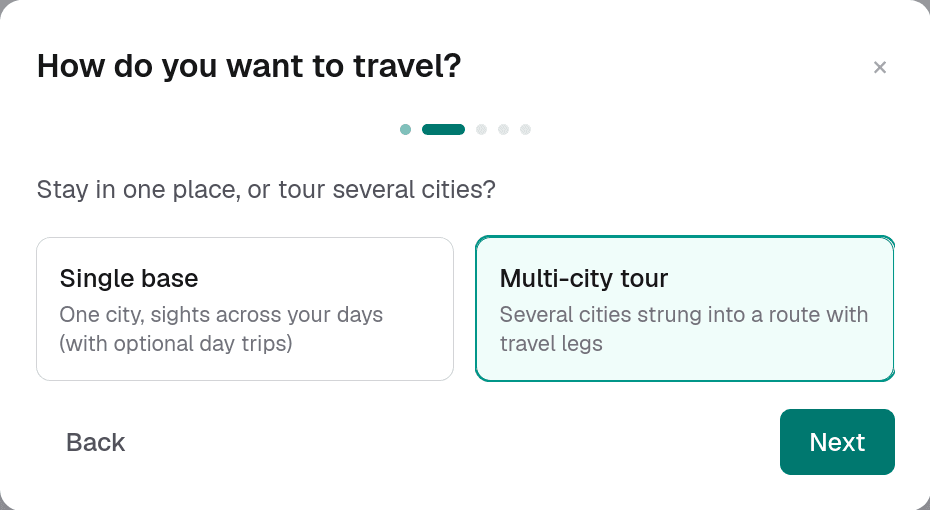
Start with one destination or several. A single city becomes a trip based there, with optional day trips out and back. Several destinations become a tour, strung into a route with travel legs between them.
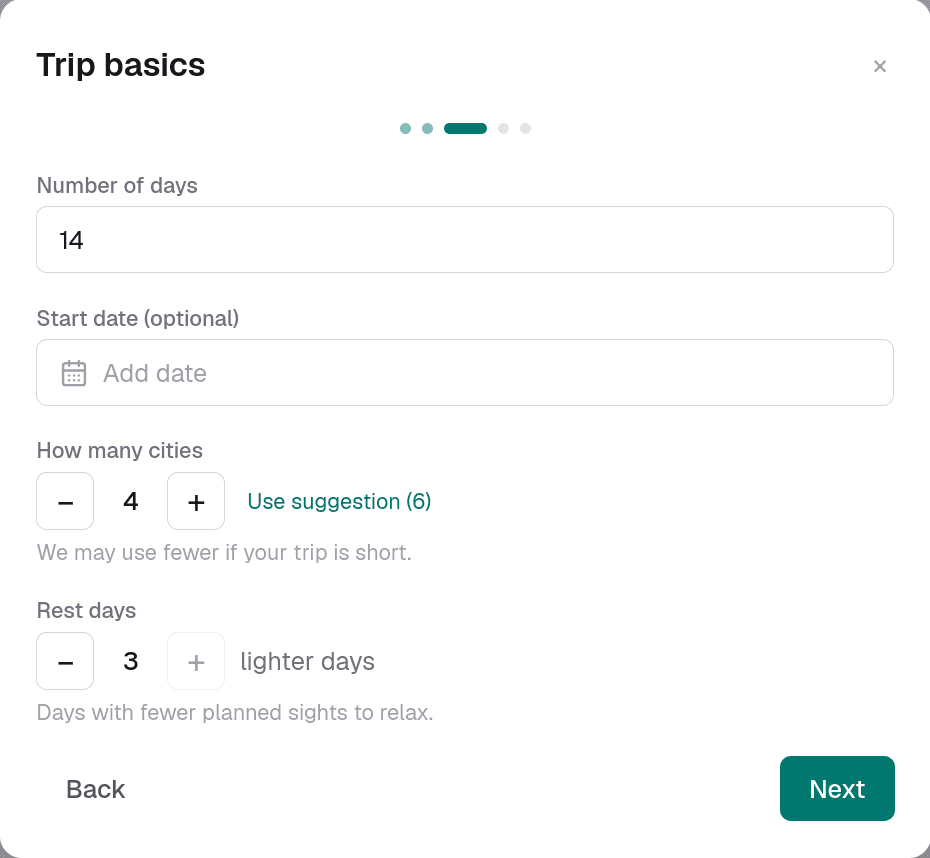
Then set the shape: anything from 1 to 21 days (120 with Plus), an optional start date, how many cities to visit, and up to three rest days so the plan is not wall-to-wall sightseeing. Choose a pace, pick the interests that matter to you, and say whether you want the famous highlights, the hidden gems, or a balance of the two.
Change your mind before anything is saved
Autocompose answers with a proposal, not a trip. Each city shows how many sights it brings, and every one of them can be swapped for an alternative from the same region, removed, or joined by another town you would rather include.
Only when you confirm does the itinerary become real: stops in order, travel legs between them, the sights attached, and the days filled in. From that point it is an ordinary JourneyComposer trip, so nothing about it is locked to the way it was generated.
Why there is no AI in it
Language models are good at sounding like a travel guide and bad at being one. They confidently produce museums with the wrong opening days, towns in the wrong valley, and drives that take twice as long as claimed, and you only find out when you are standing there.
JourneyComposer takes the opposite approach. A fixed set of rules works over structured, human-written travel data: which places are worth a stop, what there is to see, where things actually are. Ask the same question twice and you get the same answer, and every place in the result is a place that exists, because it came out of a guide rather than out of a model.
Questions
How long does it take?
About a minute, most of which is you choosing options. The plan itself is computed from data we have already crawled, so there is no waiting on a third-party service.
Can I edit the trip afterwards?
Completely. A generated trip is a normal trip: reorder stops, change the nights, swap the transport, drag sights between days, add your own places, delete whatever you do not want.
How many days can it plan?
Up to 21 days in one go for free, for one destination or several at once, across up to 8 cities. Plus extends a single autocomposed trip to 120 days and 30 cities, which is more than any real journey needs. Beyond that, split it into more than one trip.
Does it book anything?
No. It plans. Once a trip exists, train, bus, ferry, and flight legs show indicative prices and links if you want them, but nothing is ever booked on your behalf.
Try it on a trip you are already thinking about.
Pick a destination and a number of days and see what comes back. Nothing is saved until you say so.